In Thailand, students no longer need to create their own hairstyle according to a military model, and students do short haircuts. The Supreme Administrative Court in Thailand explained that haircut rules violate personal freedom limitations.
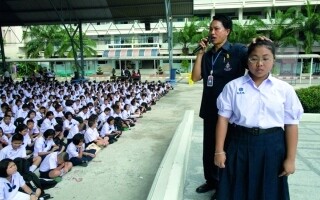
Early in the morning, a group of Thai students lined up in school uniforms, all had similar stylish haircuts, to participate in the daily ceremony of raising the flag at their secondary school in Bangkok. A twelfth grader, Param Chawanit, was among 3600 students who attended school. Teachers went through the classes to check the conformity of students' appearances and students' compliance with dress codes and external appearance rules. One of the teachers pointed to Param, known as Hao Klong, and said that his hair was too long, after which he was forced to go in front and partially cut off his hair right before school, leaving him looking disheveled all day.
"I felt confused, like a child who was chosen for teasing, and my hair was cut in such a way that it looked ridiculous," said Hao Klong, who is now studying at university for 20 years. "I looked at all my classmates, and they laughed at me, and this scene still vividly flashes in my memory."
Haircut rules in Thailand have changed significantly, and in March of last year, the Supreme Administrative Court canceled the directive established in 1975 by the Ministry of Education, declaring it unconstitutional. The court indicated that these rules imposed unreasonable restrictions on personal freedom, violating the Thai constitution.
The court's decision was expected after protests by students across the country. The issue returned to the foreground in 2020, and the Ministry of Education left the decision on establishing rules for schools at their discretion. The decision immediately approved some students wishing to freely express themselves through their appearance.
Even if it's difficult to understand the reasons for such strict rules, they reflect Thailand's conservative and pyramidal society and strict military regime, said a researcher of Thailand's educational policy, who previously wrote about dress codes in schools, Tenavit Thethrat. "The influence of the military regime on the external appearance of school students remains to this day," he said, adding that "this is a cultural value where social values indicate that students must follow the rules, and if they abide by these rules, they become good people."